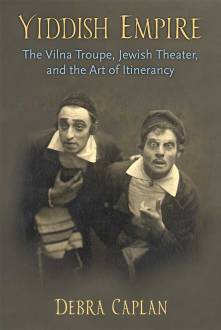
 Listening to Debra Caplan’s description of the Vilna theater troupe in early 20th century Lithuania, I was rapt, imagining myself a century ago with my ear up to an old-timey radio. Debra is an Assistant Professor of Theater in the Dept. of Fine and Performing Arts at Baruch College, and the stories in her book Yiddish Empire: The Vilna Troupe, Jewish Theater, and the Art of Itinerancy (U Michigan Press, 2018) do warrant a dramatic retelling, given the stark juxtaposition of the grueling conditions under which the actors worked and their astounding success and popularity.
The stories Debra shares about researching, writing and publishing the book are quite vivid, too. As co-founder of the Digital Yiddish Theater Project, Debra, along with other Yiddish theater scholars, has been using digital humanities in the study and preservation of Yiddish theater for several years. For this book, she overlays a modern tool on her old timey subject matter that constitutes an entire project of its own. “Visualizing the Vilna Troupe” is a fascinating and highly ambitious data visualization that looks like a beautiful uber-Spirograph.
This interview was conducted by our CUNY colleague, Beth Harpaz, the editor of SUM, the web site that showcases CUNY research. You may have heard Beth when she was on the other side of the microphone in Episode 18. Beth has journalist chops and podcast passion and is the ideal interlocutor to share her excitement about Debra’s book. You can read Beth’s SUMmary here.
Bonus book + podcast endorsement: Check out Beth’s interview with Lisandro Pérez, Professor of Latin American and Latina/o Studies at John Jay, where they talk about his recent book Sugar, Cigars, and Revolution The Making of Cuban New York. It was the inaugural podcast presented by CUNY’s Gotham Center for New York City History in partnership with New Books Network. (Have you noticed we’ve got the raw data for a Spirograph of our own incorporating the entities mentioned in this post?)
One last thing: Should this subject matter get you in the mood, Debra and Beth highly recommend the production of “Fiddler on the Roof,” in Yiddish and directed by the legendary Joel Grey, which runs through Dec. 30 at the Museum of Jewish Heritage in Manhattan.
Listen to Episode 20 now!
Subscribe on iTunes!

 In July 1947, a large group of motorcyclists – part of a “Gypsy Tour” rally – either descended upon or delighted Hollister, CA, with their presence, depending on who’s telling the story. This is the Rashomonesque tale that Sarah Hoiland tells in her recent article “Impromptu Fiesta” or ‘Havoc in Hollister’: A Seventy-Year Retrospective” in the International Journal of Motorcycle Studies. It’s a compelling story about motorcycle culture, media sensationalism and women’s dis/empowerment. Beth Harpaz, editor of CUNY SUM, wrote a synopsis of the particulars of the event and Sarah’s research journey.




 After 35 years in newsrooms, Beth Harpaz now refers to herself as a
  Having a conversation with


 Indoor Voices Podcast
You must be logged in to post a comment.